Still waking up with burning feet at night? Find Out What's Really Causing It →
Health Report Nerve Health Daily Updated May 2025

Still Waking Up With Burning,
Tingling Feet at Night?
Here's What Nobody Told You — And What's Finally Working

Because everything you've tried was targeting the wrong cause. A 2025 discovery finally reveals the hidden trigger behind nighttime burning — and why most conventional treatments never stood a chance against it.
Watch: The hidden trigger behind nighttime burning feet — explained
The hidden trigger behind nighttime burning — explained Scientists explain the hidden trigger firing inside your nerves at night — and what's finally working for people over 55

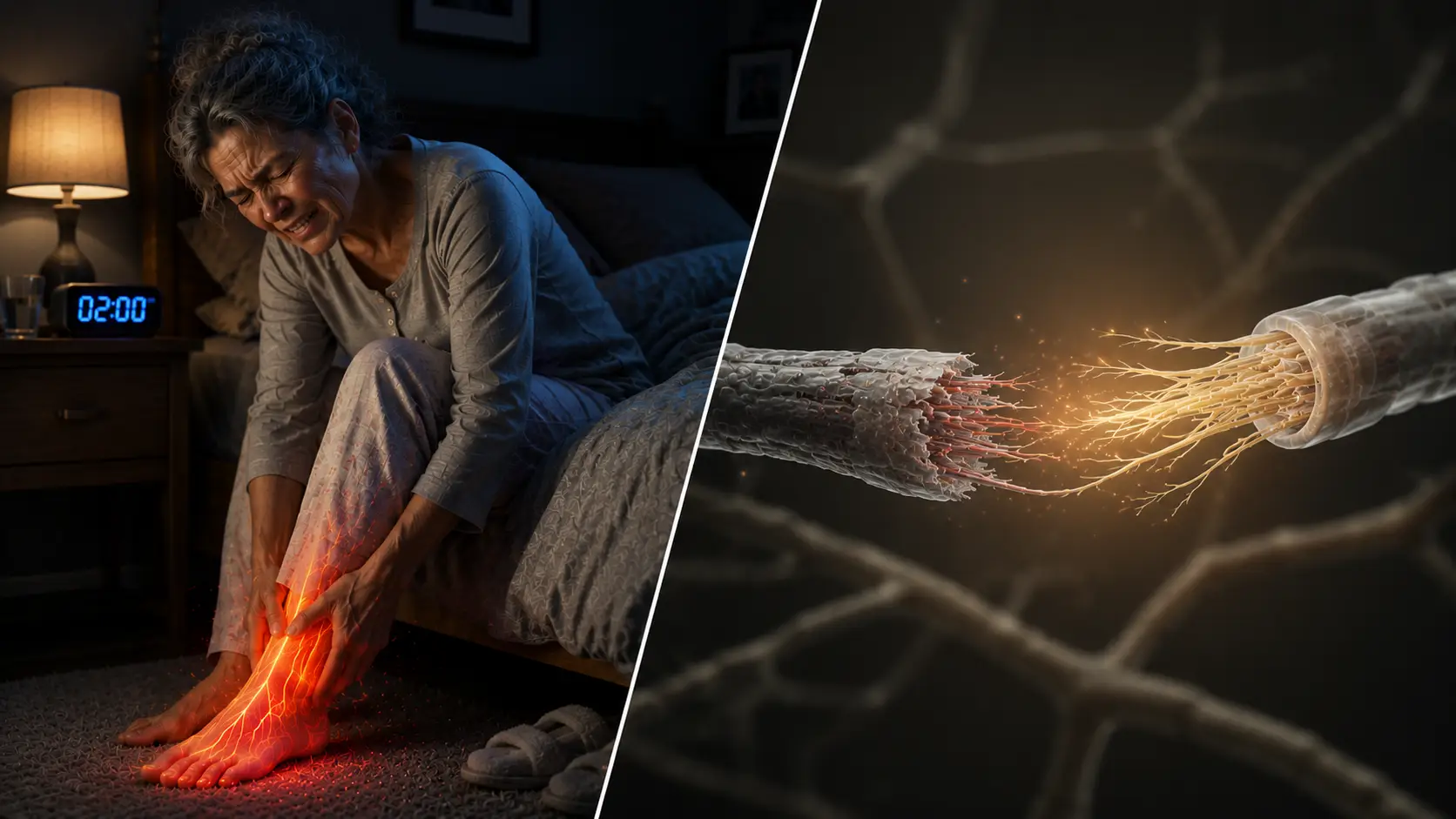
It always starts the same way. You finally lie down after a long day — and that's exactly when it begins. A slow heat building in the soles of your feet. A tingling that turns into burning. A burning that turns into something that makes sleep impossible. You check the clock: 3 a.m. You've been here before. You've tried things. And every morning you wake up exhausted, wondering why nothing works.


The Night Doesn't Lie —
Your Nerves Are Sending a Warning

You've described it to doctors. You've searched for answers at hours when you should be sleeping. You've been told it was aging, blood sugar, poor circulation — something you'd just have to learn to live with.

But here's what nobody explained: why does it always get worse at night? Why, when you're finally resting, does the burning intensify? Why does lying still make it worse instead of better? And why, no matter what you try, does it always come back?

If you experience any of these, keep reading
  • Burning or intense heat in your feet that worsens after dark
  • Tingling or "pins and needles" that wake you at night
  • Electric-shock sensations in your toes or soles
  • Needing to put your feet outside the covers for relief
  • Waking up multiple times because of foot discomfort
You are not alone. Research from the CDC shows cases of chronic nerve pain have increased over 520% in the last four decades — most affecting adults over 55. The nighttime pattern, in particular, is one of the most commonly reported yet least investigated symptoms in primary care.

The frustrating part isn't just the pain. It's the feeling that no one has a real answer. You've tried what your doctor recommended. You've tried what you found online. Some things helped briefly. But the burning always returns when the lights go off.

What most people don't know: this specific nighttime pattern — burning that intensifies at rest, that climbs slowly upward — is not random. It points to something very specific happening inside your nervous system that many people never hear explained clearly.

Why Nothing Has Worked The Real Reason the Burning Comes Back Every Night A 2025 discovery finally explains the nighttime pattern — and why it has nothing to do with age or circulation

There Is a Specific Reason
It Always Happens at Night

The nighttime pattern isn't random. It isn't age. It isn't poor circulation. In 2024, a study analyzing more than 6,000 pairs of identical twins — one with nerve pain, one without — identified a single measurable variable present in every person who suffered. Their healthy sibling didn't have it.

Research Note — 2024

When researchers compared twins with identical genetics, identical diets, identical lifestyles — the only consistent difference was a specific internal imbalance that conventional medicine has never made the focus of treatment. Every standard approach addresses the sensation. Not one addresses this.

The same pattern appeared across diabetic cases, age-related cases, and cases with no prior diagnosis. The cause was the same. The oversight was the same.

Based on: twin analysis published 2024 · NIH, 2025 · independent clinical observations

What makes this discovery significant isn't just what it found. It's what it explains — why the burning peaks exactly when you lie down, why it climbs slowly upward over months, and why every approach that came before it produced temporary relief at best.

The reason nothing has worked isn't that your nerves are beyond help. It's that everything you've tried has been aimed at the wrong target.

The cause has been hiding in plain sight — in research that most physicians haven't seen yet, tied to something present in virtually every American home. And once you understand what it actually is, the nighttime burning pattern makes complete sense for the first time.

The Other Side of This Discovery What the Twin Study Actually Found — And Why It Changes Everything The cause most people with nighttime burning have never been shown

Why I Spent Eight Months
Investigating This

Dr. Helena Marsh
Dr. Helena Marsh
Health Journalist · Wellness Researcher · 14 years covering integrative medicine

Former contributing editor at three national health publications. My research focuses on the gap between what conventional medicine recommends and what emerging science is actually discovering.

My mother was 68 when the burning started. She described it the same way everyone does — "like my feet are on hot coals, but only at night." She'd walk the hallway at 3 a.m., pressing her feet to the cold floor tiles, embarrassed to tell anyone how bad it had gotten.

Her neurologist said peripheral neuropathy, probably age-related, possibly connected to her blood sugar. He adjusted her medication. It didn't change. He said it might be progressive. She stopped asking questions. She started sleeping in the living room recliner because lying flat made it unbearable.

That's when I started digging — not as a journalist, but as a daughter watching someone she loves lose sleep every single night. What I found over the following eight months completely changed how I understand nerve pain.

The research is not fringe science. It has been published in peer-reviewed journals and replicated across multiple independent teams. What it isn't, yet, is mainstream. Most physicians are still working from guidelines written before this evidence existed.

That gap — between what the research shows and what most people with nighttime burning are being told — is exactly why this report exists.

What My Mother Did Next How She Finally Slept Through the Night — Eight Months of Research in One Place The discovery that changed everything — and why most people with nighttime burning have never heard it

"I stopped expecting to sleep well."
Until They Found This

These are accounts from people who, after years of nighttime burning, finally found out what was actually behind it. Their words have been lightly edited for length.

I had been waking up at 2 a.m. for almost three years. My feet felt like I'd stepped on hot coals — no visible reason, no relief. I tried everything my doctor suggested, then everything I could find on my own. Nothing touched it. Once I understood what was actually behind the pattern, things started to shift in a way nothing before had. My daughter thought something was wrong because I wasn't walking the hallway anymore.
Patricia M.
★★★★★
Patricia M. Age 71 · Texas · 3+ years with nighttime burning
The worst part wasn't the pain itself. It was watching my husband worry every time I got up at night. My doctor called it "idiopathic" — no explanation. Finding out there was a specific, measurable reason behind it — something my doctor had never looked at — was a relief before anything else even changed. The heat in my feet at night is a fraction of what it used to be.
Sandra L.
★★★★★
Sandra L. Age 64 · Ohio · No prior diagnosis found
What Patricia and Sandra Had in Common The Hidden Trigger They Finally Identified — And What Followed The same pattern — burning that comes back every night — points to one specific cause
For Everyone Still Waking Up in Pain
If Your Feet Burn at Night, This Is Why — Find Out Here →

The discovery most people with nighttime burning have never been shown.

What Most People Ask —
And What the Research Actually Says

These are the three questions that came up most often after publishing this report — and the ones conventional medicine rarely answers directly.

Most conventional approaches work by reducing the sensation your brain receives — not by addressing what may be causing the nerve to misfire in the first place. A 2025 NIH study found fewer than 10% of patients on neuropathy treatments see meaningful long-term improvement. When the underlying pattern continues unchecked, higher doses become necessary over time and the burning tends to return. The nighttime pattern comes back because its root may never have been addressed.

High blood sugar does affect nerve tissue over time — that's accurate and well documented. But research now suggests there may be additional contributing factors that operate independently of glucose levels — present across diabetic and non-diabetic cases alike. Many people with nighttime burning have normal blood sugar. Many diabetics manage their glucose well and still experience the nighttime pattern. Addressing the full picture tends to produce better outcomes than addressing only one part of it.

Some of the research pointing to specific contributing factors in nerve pain only reached peer-reviewed publication in the last two years. Most clinical guidelines in use today were written before this evidence existed. The average lag between published research and standard medical practice is 10 to 17 years, according to the NIH. This isn't a reflection on your doctor — it's simply how slowly the system updates. You may be ahead of what most clinics have access to.

For Everyone Still Waking Up in Pain
If Your Feet Burn at Night, This Is Why — Find Out Here →

The discovery most people with nighttime burning have never been shown.